Modern historical fencing presents itself as a revival of historical fencing traditions. Manuals are studied, techniques reconstructed, and lineages discussed. Yet if we are honest, much of today’s HEMA is shaped more by online culture than by the traditions it claims to revive.
Let’s set the bar higher.
Fencing has always carried clear expectations of conduct and character. It developed in military, aristocratic, and bourgeois settings where discipline, self-restraint, and sound judgement were seen as integral to the practice and to the person. Modern HEMA, unfortunately, often tells the opposing story. Reputation is negotiated in comment sections, conflicts play out in public, and claims are distorted and amplified without accountability. It is an embarrassing fact that Olympic fencing does a better job of upholding the values historically associated with the sword. So the question is a simple one. Who are you as a fencer? What kind of culture are you contributing to?
Historically, the right to practise and carry a sword was not merely a matter of personal defence; it was a profound social responsibility. As historical research into the martial ethic of early modern Europe shows, martial capability was deeply tied to civic duty, honour, and one’s standing in society. To possess the capacity for violence meant you were expected to possess the discipline to govern it. Unrestrained aggression was the mark of a brawler or a criminal; disciplined restraint was the mark of a fencer. As fencing later evolved deeper into polite society, this core principle remained unchanged: you were expected to demonstrate absolute mastery over yourself before attempting to master an opponent.
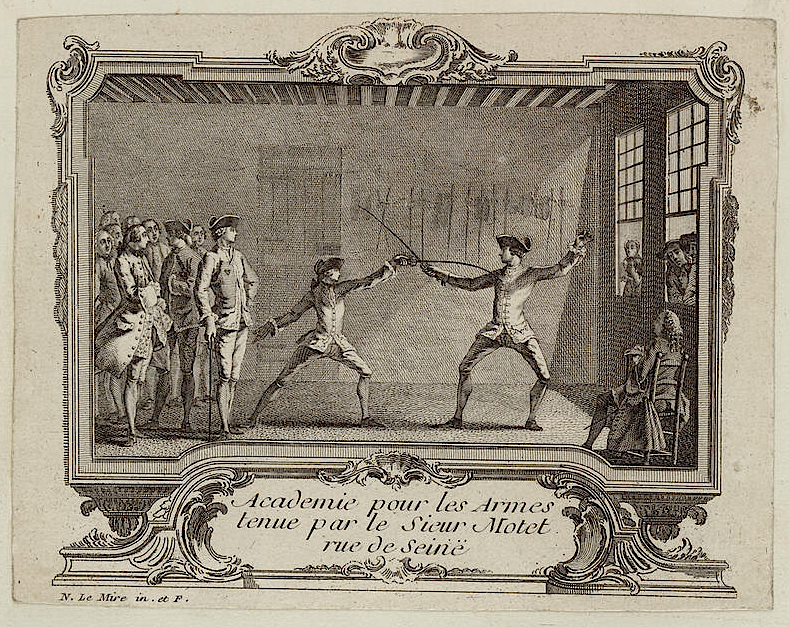
This reality is clearly reflected in the surviving rules of historical fencing halls. The ordinances of the early modern Fechtschulen and the later salles d’armes did not just regulate martial technique; they heavily penalised failures of character. Losing one’s temper, acting with malice, swearing, or bringing outside quarrels into the hall were offences met with fines or expulsion. The hall was a sanctuary for pedagogical combat. It required a rigid framework of decorum to ensure that the practice of martial arts remained a constructive, civilised pursuit rather than a descent into chaos.
When we look at such historical rules today, we often misunderstand them as mere etiquette or disciplinary policy. This is because modern society suffers from a profound cultural blind spot. As philosopher Alasdair MacIntyre has observed (in After Virtue), we have largely lost the language and comprehension of traditional virtue ethics. In its place, we are left with what MacIntyre calls ’emotivism’—a state where moral arguments are reduced to mere expressions of personal feeling and attempts to manipulate others. This is the exact root of the toxic online culture we see today: a shouting match of preferences disguised as principles.
For over two millennia, our ancestors possessed a different, ingrained understanding. They knew that character is not a checklist of modern rules, but something cultivated through habit towards a higher purpose. They did not separate the physical act from the moral state of the actor.
Therefore, the virtues of a fencer are not arbitrary moral additions or modern inventions. They are the historical operating system of the art.
Virtue in this context is a practical, trained skill. Just as a fencer trains the body to find the correct measure, they must train the mind to maintain composure. It is an ongoing calibration forged through habit. Courage without restraint becomes recklessness. Confidence without humility decays into arrogance. True skill lies in the capacity to execute the art with control over both the weapon and the ego.
The qualities outlined below articulate this enduring standard. By cultivating them, we refuse to let the worst of modern online behaviour corrupt the heritage of the sword. Instead, we carry these historical values forward, allowing the practice of fencing to be a positive, civilising force in our own time—both within the hall and in society at large. They are the foundation that allows historical fencing to function as an art, ensuring that the fencer remains worthy of the practice.
Respect

Respect is foundational. At its core, it is the profound recognition of another human being. It governs how we treat others in training, competition, and conversation. Historically, disrespect in a martial context was a dangerous failing. By extending respect to one another, we forge genuine fellowship and community out of a martial practice.
A fencer meets every person as an individual and judges them solely by their conduct, character, and dedication to the art—never by collective identity, sex, ethnicity, or similar superficial markers. The salle is a meritocracy of character and effort.
In practice, respect means being attentive, controlled, and fair. You train in a way that protects your partner, you listen when others speak, and you contribute to an environment where people can develop without interference.
“It is forbidden: To curse the name of God… To hold any discussion on indecent subjects… To make fun of a student taking a lesson or during an assault… To sing, whistle, or fool around, or mock some students… To say, either at the wall or at the assault, I have touched, or such meaning… To get angry during fencing or to mock some student…“
Navarre, M.C. Manuel Militaire, ou L’Art de Vaincre par L’Épée. Paris, 1775
Courtesy
Courtesy is an expression of respect, kindness, and consideration toward others. It is shown through one’s behaviour, words, actions, and tone. A fencer demonstrates through his conduct that he values the dignity and presence of those around him. Courtesy goes beyond rules of etiquette or polite formulas. It is an inner attitude, but one that must be made visible in action. In fencing, it manifests in the salute, the handshake, and in proper conduct throughout training. It sets the tone for how the art is practised. Courtesy does not end in the salle. It carries into how one speaks about others and how one behaves more broadly. At its core, courtesy means treating others as one would wish to be treated, not out of obligation, but as a matter of character. It is one of the clearest ways to show that we take both the art and each other seriously.
Integrity
Integrity is the alignment of word and action, driven by a commitment to truth. It means being reliable and honourable: when we agree on how to train, we follow that agreement. When we make a commitment, we keep it. Integrity also demands that we are truthful and fair in how we speak. We do not exaggerate, distort, or present speculation as fact. Gossip, slander, and false accusations are entirely incompatible with the fencing spirit. We do not engage in rumour-spreading or public attacks, nor do we take part in mob behaviour online or in person. A healthy fencing culture depends on individuals upholding truth and taking absolute responsibility for their words.
Humility
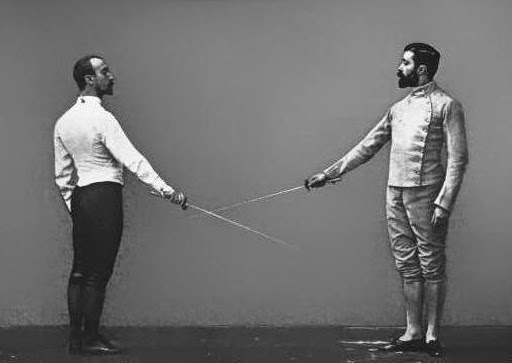
Humility is a clear understanding of one’s place in the art. Fencing is a vehicle for growing physically, mentally, and spiritually, which means no one is finished, and no one stands above the process. There is always more to learn, and often more than one way to understand what is being practised. In training, humility means listening, observing, and being willing to adjust. It means accepting correction without resistance and recognising that others may see what you do not. Crucially, humility requires honesty with oneself. A fencer must be able to recognise both strengths and limitations without distortion. Without that, progress stops. With it, true development becomes possible.
Self-Control
Self-control is the ability to govern your reactions. Training and competition will inevitably challenge this. We will experience frustration, failure, and physical pressure. These situations are not interruptions to the practice; they are the practice. A fencer learns to remain composed. We do not lose our temper, we do not escalate situations, and we do not allow emotions to dictate our behaviour. Control allows training to remain safe, focused, and civilised, even when intensity increases.
Courage
Courage is the martial heart of fencing. It is the willingness to act rightly under physical and psychological pressure. In practice, courage is stepping into measure, taking the initiative, and facing the blade without flinching. It is the resolve to maintain your structure and technique when everything tells you to retreat. However, physical courage must be matched by moral courage. It is the fortitude to honestly acknowledge a hit, to stand by your actions, and to do what is right even when it is difficult or unpopular.
Presentation & Modesty
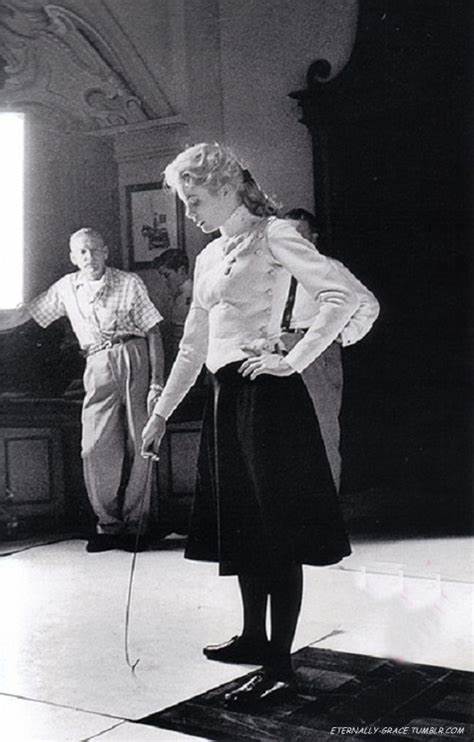
How we present ourselves is an outward expression of our inner ideals. Fencing possesses an inherent beauty, and a fencer’s style should always be classic, restrained, and traditional to reflect this. This approach shows that we take the art, and our fellow fencers, seriously. Modesty in this context does not mean diminishing oneself; it means allowing the practice to take precedence over the ego. A fencer’s appearance must reflect the reality of a martial discipline. The salle is a place for the refinement of skill and character, not a venue for theatrical display at the expense of the art.
Furthermore, how we look dictates how the outside world perceives us. By presenting ourselves with dignity and an appreciation for the art’s inherent beauty, we elevate the community and attract new people, showing them a serious and inspiring ideal rather than a spectacle.